
Embryologist
Experience: 8 years

How do embryologists work?
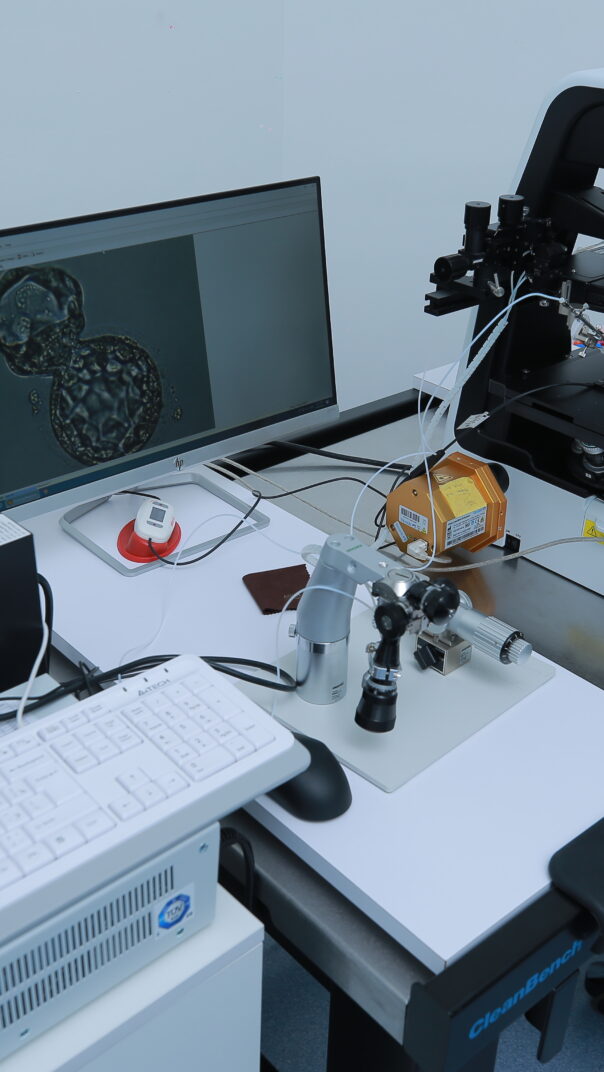
This specialist studies the development of the human body from fertilization to birth. The work of an embryologist plays a major role in infertility treatment programs. This is achieved by creating favorable conditions for artificial insemination using high-tech medical equipment.
During insemination, the embryologist places sperm into the uterus and evaluates the quality of the oocytes and sperm, reporting the fertilization result.
In vitro fertilization directly depends on the results of embryological studies. The IVF procedure itself has become possible thanks to advances in medical technology, the development of high-tech equipment, and clinical embryology.
The latter studies the development of the human body and the causes of abnormalities during organ formation and possible developmental disorders. It also provides answers to questions about how to influence embryogenesis. Embryologists are the specialists who facilitate the conception of life in vitro, performing fertilization in cases where diseases complicating this process have been diagnosed.
It is the embryologist who evaluates the quality of conception; their ability to culture the fertilized egg ensures the success of IVF.
During the procedure, follicles containing eggs are collected from the patient and sent to the laboratory, where the embryologist selects suitable eggs. The same process occurs during sperm selection, with the most active sperm selected.
Fertilization is performed in two ways: in vitro or by ICSI injection. In the former, sperm are added to eggs placed in a nutrient medium; in the latter, the highest-quality sperm is implanted into the egg using special instruments.
What is an embryological protocol?
The embryological data obtained during the process is recorded in a special document called an embryological protocol. It describes all information related to embryo cultivation.
Eighteen hours after the procedure, the embryologist can provide preliminary information on the number of fertilized eggs. They are then closely monitored by the embryologist, who can provide an objective assessment two days after fertilization. The physician examines the visual appearance, the thickness of the membrane forming around the embryo, and the fragmentation and order of the cells.
Doctors conventionally divide all resulting embryos into four types:
– excellent
– good
– satisfactory
– unsatisfactory.
The most promising embryos are selected for implantation into the patient’s uterus, from which one or two are selected and transferred into the mother’s womb.
The success of an IVF procedure depends largely on the embryologist’s work and on how closely the fertilization and culture conditions match natural conditions. Embryo transfer is typically performed on day 5, but this is also done if several excellent-quality embryos are available. If only 1-2 embryos are available, transfer is performed on day 2 or 3.
Thus, embryology makes successful artificial insemination possible, allowing many infertile couples to experience the joys of parenthood.

| Service Name | Service Fee (UZS) |
| Embryo thawing and biopsy for genetic analysis | 6 000 000 |
| NGS of 1 embryo | 5 600 000 |
| NGS of 2 embryos | 10 000 000 |
| NGS of 3 or more embryos (per embryo) | 4 500 000 |
| Freezing beyond 5 straws (per straw) | 500 000 |
| Sperm freezing | 1 350 000 |
| Sperm banking | 1 000 000 |
| Thawing and transfer of 1 embryo | 5 600 000 |
| OPU + oocyte banking | 9 000 000 |
| ICSI after oocyte banking | 18 000 000 |
| Follicle puncture for banking | 6 760 000 |